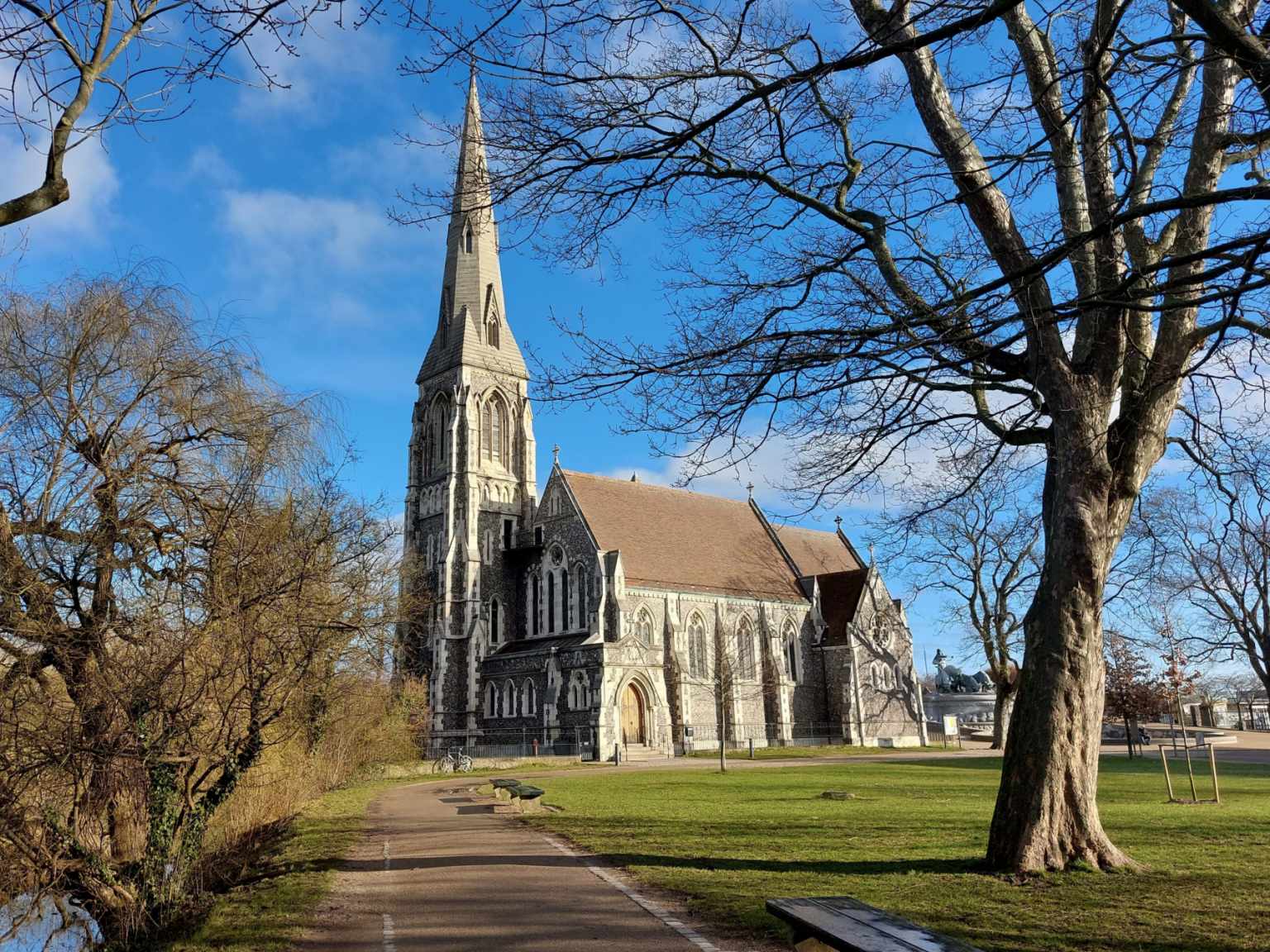
St Alban's Church

Churchill Parken 6, Langelinie, DK 1263, Copenhagen, Denmark | Map


Today is: Saturday 4th February, 2012

What is the Anglican Church?

The Anglican Church is an affiliation of independent national or regional churches in full communion with the Church of England (which may be regarded as the “Mother Church” of this worldwide family). So, more accurately it should be refered to as the Anglican Communion. There are currently 77 million Anglican Christians in the world.The Archbishop of Canterbury, the most senior archbishop of the Church of England, whilst having no formal authority outside his own English jurisdiction, is recognised by the churches of the Anglican Communion as a symbolic and historic focus and he is honoured as being “first amongst equals” amongst the other archbishops.

While Anglicans acknowledge that the repudiation of papal authority by Henry VIII of England resulted in the Church of England existing as a separate entity, they also believe that it is in continuity with the pre-Reformation Church of England. By the end of the 17th century the Church of England was describing itself as both Catholic and Reformed – it maintained the creeds and threefold ministry of the deacon, priest and bishop and also outlined its theological disagreements with the Roman Catholic Church but without following the influence of any particular Protestant Reformer. One reformation historian, MacCulloch, comments on this situation by saying that the Church of England “has never subsequently dared to define its identity decisively as Protestant or Catholic, and has decided in the end that this is a virtue rather than a handicap.”

Consequently there is a very wide divergence of opinion and worship-style to be found within Anglican churches – Catholic, Liberal, Evangelical – and everything in between. Traditionally the Anglican Church has been termed a “broad church”, a large home in which people can find somewhere to worship, learn and find friendship. The advice of St Augustine rings true to Anglicans: “in the primary things, unity; in the secondary things, generosity; in all things, charity”. Worship is most important for Anglicans and, indeed, the English Reformation is best known, not for drawing up dogmatic documention, but for creating a book of common prayer. It is as though instead of Anglicans wanting people to sign on dotted lines, they instead prefer to offer them a prayer book, inviting them to join in and to learn who they are, and what they believe, by immersing themselves in their liturgical landscape. Because Anglicans have a high doctrine of the Mystery of God they have a defined tradition of music, poetry and art which both enriches their worship of God and teaches human souls to fly nearer the divine reality God, unveiled in his body-language and self-portrait, Jesus Christ.

The four defining points which focus Anglican belief, identity and practice have been identified as:

  1. The Holy Scriptures of the Old and New Testaments, as “containing all things necessary to salvation”, and as being the rule and ultimate standard of faith.
  2. The Apostles’ Creed, as the baptismal symbol: and the Nicene Creed, as the sufficient statement of the Christian faith.
  3. The two sacraments ordained by Christ himself – Baptism and the Supper of the Lord – ministered with unfailing use of Christ’s words of institution, and of the elements ordained by him.
  1. The historic episcopate, locally adapted in the methods of its administration, to the varying needs of the nations and peoples called of God into the unity of his Church.

This means that as Anglican Christians reflect theologically and ethically they hold together the primacy of the Scriptures with the traditions of the Christian Church, as well as using the gift of human reason and the insights of contemporary learning and experience. Whereas many vocal Christians are those with extreme views, the Anglican way has often been termed the “via media”, the middle way, between Rome and Geneva, between Roman Catholicism and Protestantism, between biblical fundamentalism and papal infallability, between an unthinking traditionalism and an unreflective relativism.
As one Archbishop of Canterbury, Robert Runcie, put it in 1981:

“Compared with Rome, Anglicanism has a higher evaluation of the primitive over the medieval tradition of the Church. Compared with Constantinople, it has a higher evaluation of the European Renaissance and Enlightenment , and a greater respect for the autonomy of the scientific method and the realm of ethics. Compared with Lutheranism, it is less sharply defined doctrinally, but more insistent on the centrality of liturgy and worship in the life of the Church…In the matter of doctrine, the Anglican tradition has been to insist on adherence to the primitive catholic faith while allowing a greater diversity of theological opinion than is permissible in other Episcopal churches, and not proceeding to what has been seen as the over-systematization and definition of doctrine which was given an unhappy impulse by the religious quarrels of the sixteenth century and which has proceeded to our own day, creating new dogmas out of inessentials, which really ought to be left in the realm of theological opinion.”

Useful Resources

For a short and accessible introduction to Anglican tradition you might look at How to Be an Anglican by Richard Giles (Canterbury Press). Other books and websites which might be helpful are:

Websites

The Anglican Communion

The Anglican Communion is a world-wide affiliation of Anglican Churches. There is no single “Anglican Church” with universal juridical authority, since each national or regional church has full autonomy. As the name suggests, the Anglican Communion is an association of these churches in full communion with the Church of England (which may be regarded as the “mother church” of the worldwide communion), and specifically with its primate, the Archbishop of Canterbury. With over seventy seven million members, the Anglican Communion is the third largest communion in the world, after the Roman Catholic Church and the Eastern Orthodox Churches.

The status of full communion means that all rites conducted in one church are recognised by the other. Some of these churches are known as Anglican, explicitly recognising the link to England (Ecclesia Anglicana means “Church of England”); others, such as the American and Scottish Episcopal churches, or the Church of Ireland, prefer a separate name. Each church has its own doctrine and liturgy, based in most cases on that of the Church of England; and each church has its own legislative process and overall episcopal polity, under the leadership of a local primate.
The Archbishop of Canterbury, religious head of the Church of England, has no formal authority outside that jurisdiction, but is recognised as symbolic head of the worldwide communion. Among the other primates, he is primus inter pares, or “first among equals.” He has no jurisdiction outside his own province. Nonetheless, churches are not considered to be in the Anglican Communion unless they are in full communion with him [ 1 ].

The Anglican Communion considers itself to be part of the One, Holy, Catholic, and Apostolic Church and as being both Catholic and Reformed. For some adherents it represents a non-papal Catholicism, for others a form of Protestantism though without a dominant guiding figure such as Luther, Knox, Calvin, Zwingli or Wesley] For many Anglicans their self-identity represents some combination of the two: the communion encompasses a wide spectrum of belief and practice including evangelical, liberal, and catholic.

The Anglican Communion is one of the largest Christian denominations in the world with approximately 77 million members. [ 3 ]